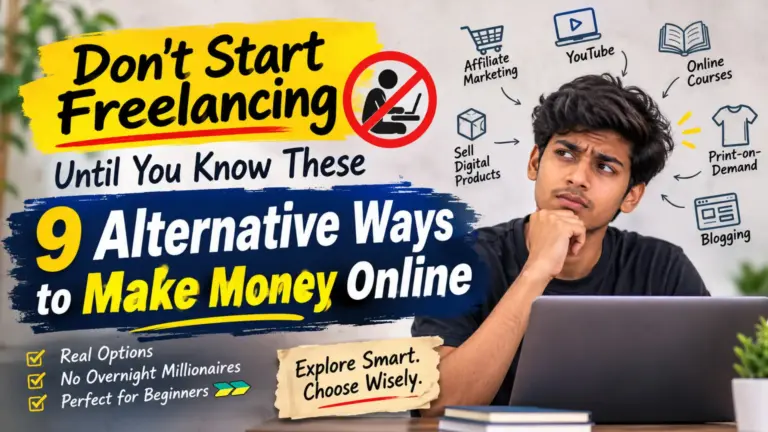
Let's get one thing straight: making money online is not as easy as YouTube thumbnails make it look. Most beginners spend weeks watching income screenshots, buying courses, joining Telegram groups, and jumping between websites that promise ₹5,000 per day for doing almost nothing.
Then reality hits.
You don't get paid for watching motivational videos. You don't earn just because you created an account on a website. And nobody is going to send you money simply because you want to work online.
But there are genuine ways to build an online income without becoming a freelancer, chasing clients, or spending your entire day applying for jobs.
Some require writing. Others need basic design skills, patience, marketing knowledge, or a little technical ability. A few can be started with almost no money, while others need an initial investment.
I've picked nine options worth understanding before you jump into freelancing.
One warning: None of these methods guarantees earnings. You might spend weeks or months working without receiving your first payment. That's normal. If you need guaranteed money by next week, these are probably not your answer.
Let's get into it.
Affiliate marketing is one of the first business models I'd suggest learning if you want to make money online without selling your own products. The concept is simple. You recommend someone else's product or service using a special tracking link. When someone purchases through your link, you receive a commission.
For example, imagine you run an Instagram page about AI tools. You publish tutorials, comparisons, and reviews of different software.
Some of those tools offer affiliate programs. You can recommend them in your content and earn a commission when people sign up or purchase through your link. You don't need to manufacture anything, handle delivery, or manage product inventory.
Sounds easy?
Not really.
The difficult part is getting people to trust your recommendations. Nobody wants to click random links posted by an account that only shares promotional content. You need an audience, useful content, and products that genuinely solve problems.
How to get started:
Investment: Can be started with a low budget, depending on your platform.
Time to first payout: Potentially weeks or months. You may earn nothing initially while building traffic and trust.
Who should skip this: If you hate creating content, don't want to learn marketing, or expect people to purchase products just because you shared a link, skip it.
You don't always need physical products to run an online business.
Digital products are downloadable or online resources that customers purchase. Think of ebooks, templates, spreadsheets, planners, printable designs, website themes, and educational resources.
Let's say you're good at using Canva.
You could create social media templates for small businesses and sell them online. A customer purchases the template, downloads it, and uses it for their own business. Another example: If you understand personal budgeting, you could create an expense-tracking spreadsheet.
The product doesn't need to be complicated. It needs to solve a specific problem. And please don't create another generic 50-page ebook just because somebody on YouTube claims ebooks make thousands of dollars. Nobody needs another useless eBook.
How to get started:
Investment: Low to moderate, depending on the software and selling platform.
Time to first payout: It could happen within weeks if you already have an audience, but starting from zero can take considerably longer.
Who should skip this: If you don't enjoy creating things, researching customer problems, or promoting your own products, this isn't a good starting point.
Imagine selling T-shirts, hoodies, mugs, phone cases, and tote bags without purchasing hundreds of products in advance. That's the basic idea behind print-on-demand. You create a design and upload it to a print-on-demand platform. When someone orders your product, the printing company handles production and shipping.
You earn the difference between your selling price and the total costs.
For example, you create a T-shirt design for people who love gaming. You list it in your store, and a customer places an order.
The supplier prints the design and ships the product. You don't need a warehouse. But don't mistake that for an easy business. Finding designs people actually want to purchase is difficult. Competition is everywhere, and your profit can become very small after production costs, platform fees, advertising, and other expenses.
A store full of random AI-generated designs won't automatically attract customers.
How to get started:
Investment: Low to moderate. You may need money for samples, store setup, and promotion.
Time to first payout: You could receive an order relatively quickly, but getting consistent sales can take months.
Who should skip this: If you don't enjoy design, researching trends, or testing products, and you have absolutely no budget for business expenses, skip this one.
Blogging isn't dead. Bad blogging is.
There is a difference. Instead of creating a website about everything, choose one specific subject and publish useful articles around it. For example:
Let's take an AI tools website as an example.
You can publish software reviews, tutorials, comparisons, pricing guides, and articles explaining how to use different tools. Once your website starts attracting visitors from Google and other sources, you can explore different monetization options.
These may include display advertisements, affiliate marketing, sponsored articles, and your own digital products.
But here's the boring part.
You might publish 30 articles and still receive very little traffic. Search engines don't owe you visitors. Ranking takes time, and some articles may never perform well.
Blogging is a long-term project, not a quick payment method.
How to get started:
Investment: Low to moderate, depending on hosting, domain, and other expenses.
Time to first payout: Often several months or longer when starting from zero. There is no guaranteed timeline.
Who should skip this: If you hate writing, don't want to learn SEO, or cannot consistently publish and improve articles, don't start a blog.
You don't need to be a university professor to sell an online course. You need to know something useful and be able to explain it properly. For example, you might understand:
You can turn that knowledge into recorded lessons and sell access to students.
Let's say you know how to build a WordPress website. You could create a beginner-friendly course explaining everything from purchasing a domain to publishing a working website. The advantage is that you don't need to personally teach every student if your course is recorded.
But creating a course is only half the job.
Getting customers is another challenge. People are becoming more careful about purchasing online courses because the market is full of recycled information and exaggerated promises. Your course needs to deliver something useful.
How to get started:
Investment: Low to moderate, depending on your recording equipment and platform.
Time to first payout: It may take weeks or months to create the course, build trust, and find paying students.
Who should skip this: If you don't understand your subject well enough to answer students' questions, or you dislike explaining things, don't sell a course.
Here's an interesting business model that doesn't get as much attention from beginners. Website flipping means creating or improving a website and eventually selling it to someone else. Think of it like buying an old property, improving it, and selling it at a higher price. Except you're working with websites.
For example, you could create a niche blog about gardening.
Over time, you publish useful articles, improve its design, build traffic, and develop its monetization. Once the website has a proven history and value, you can look for a buyer.
You can also purchase existing websites that need improvement, but that requires additional knowledge because a website may have hidden technical, traffic, or revenue problems.
And no, installing WordPress, publishing five articles, and asking someone to pay ₹1 lakh isn't website flipping. You need something worth buying.
How to get started:
Investment: Moderate. You may need money for domains, hosting, development, and acquiring existing websites.
Time to first payout: Usually a longer-term project. Building a website with enough value to attract buyers can take months or longer.
Who should skip this: If you don't understand websites, SEO, analytics, or basic business valuation, don't invest money in buying websites yet.
You don't need to build the next ChatGPT or Facebook to make money from software. Sometimes, a small tool solving one annoying problem is enough to create a business.
This is where Micro-SaaS comes in.
A Micro-SaaS is a relatively small software product designed to solve a specific problem for a particular audience. Some examples:
Imagine building an online invoice generator specifically for small Indian businesses. Users visit your website, enter their details, generate invoices, and potentially pay for additional features.
You can charge a subscription, offer a one-time purchase, or use a free version with paid features.
But there's a catch.
Building the tool is not necessarily the hardest part. Finding people who need it and convincing them to pay is often much harder. Also, software requires maintenance. Bugs, hosting costs, security, and customer support don't disappear after launch.
How to get started:
Investment: Low to high, depending on the complexity and technology involved.
Time to first payout: It could take weeks or months to validate the idea and attract paying customers. Some tools never make money.
Who should skip this: If you have no interest in technology, problem-solving, testing, or maintaining a product, don't start building software just because AI makes it look easy.
YouTube is still an option worth considering, especially if you can explain things, entertain people, or demonstrate useful skills.
And you don't necessarily need to show your face. You can create:
For example, you could start a YouTube channel explaining how to use different AI tools. You record your screen, demonstrate the features, explain the limitations, and publish the video. Over time, you can explore YouTube monetization, affiliate commissions, sponsorships, and your own products.
But don't start a channel expecting YouTube to pay your electricity bill next month.
Getting views is difficult. Getting returning viewers is harder. And meeting monetization requirements doesn't automatically mean meaningful income. Shorts can bring attention, but views and revenue are two different things.
How to get started:
Investment: Low if you already have a smartphone or computer.
Time to first payout: Potentially months or longer. You need to build an audience and meet the applicable monetization requirements.
Who should skip this: If you cannot handle low views initially, dislike making videos, or plan to upload copied content, don't start a YouTube channel.
This is probably one of the more practical options for students and beginners who already have knowledge of a particular subject. You don't need to create a complicated business.
You can teach online.
For example, if you're good at mathematics, English, science, computer basics, or a particular school subject, you could offer online classes to students.
You can teach through video calls, online tutoring platforms, or your own social media presence. You could also teach practical skills such as Excel, graphic design, or beginner-level website development. Unlike blogging or YouTube, you don't necessarily need to wait months to build a large audience. You can start looking for individual students.
However, getting the first few students still requires trust and promotion. And teaching takes time. You are exchanging your knowledge and hours for payment.
How to get started:
Investment: Very low if you already have a smartphone or computer and a stable internet connection.
Time to first payout: Potentially within weeks if you find students quickly, but it isn't guaranteed.
Who should skip this: If you lack patience, cannot explain concepts clearly, or don't enjoy interacting with students, this isn't for you.
Don't try all nine simultaneously. That's how beginners waste six months and achieve nothing.
Your choice should depend on what you already know, how much money you can invest, and how much time you can give.
Here's a simple comparison:
| Method | Starting Cost | Main Skill Required |
|---|---|---|
| Affiliate Marketing | Low | Marketing and content |
| Digital Products | Low–Moderate | Creation and marketing |
| Print-on-Demand | Low–Moderate | Design and research |
| Niche Blogging | Low–Moderate | Writing and SEO |
| Online Courses | Low–Moderate | Teaching and expertise |
| Website Flipping | Moderate | Websites and SEO |
| Micro-SaaS | Low–High | Technology and problem-solving |
| YouTube | Low | Content creation |
| Online Tutoring | Very Low | Teaching |
These are relative starting-cost estimates, not guaranteed budgets. Actual expenses depend on the tools and platforms you choose.
If I were starting again with limited money, I wouldn't immediately purchase expensive courses, software subscriptions, or advertising packages.
I'd choose one method based on my existing skills.
Here's how I'd approach it:
And one more thing.
Don't confuse revenue with profit. A person showing ₹1 lakh in monthly sales might be spending ₹90,000 to generate it. Always look at actual expenses, refunds, platform fees, and the money left after everything is paid.
Avoid anyone promising guaranteed daily earnings, asking for money to release your salary, or selling secret methods that supposedly work without effort.
There are genuine ways to earn online.
But they all require something: time, knowledge, patience, money, or a combination of these.
Start small. Learn one skill. Build one thing. Find real customers.
That's a much better starting point than buying another course promising to make you rich in 30 days.
This post was published on November 22, 2026 1:10 AM
The AI influencer revolution isn’t just about viral posts or futuristic avatars—it’s a $15 billion… Read More
With rising healthcare costs and unexpected medical emergencies, having the best health insurance in India… Read More
Discover the top high-income AI business ideas for 2025 that require zero coding skills or… Read More
In today's fast-changing world of content creation, the right vlogging camera can boost your video… Read More
Affiliate marketing continues to be one of the fastest, simplest, and most profitable ways to… Read More
Artificial Intelligence (AI) is transforming every corner of the digital world — and influencer marketing… Read More
Anantvijaysoni is a free resource site for Beginners. The main goal of our site is to provide quality money making tips, tricks, hacks, and other resources that allows all beginners to improve their site(s).
This website uses cookies.



Leave a Comment